

How To Pick A Camera Lens
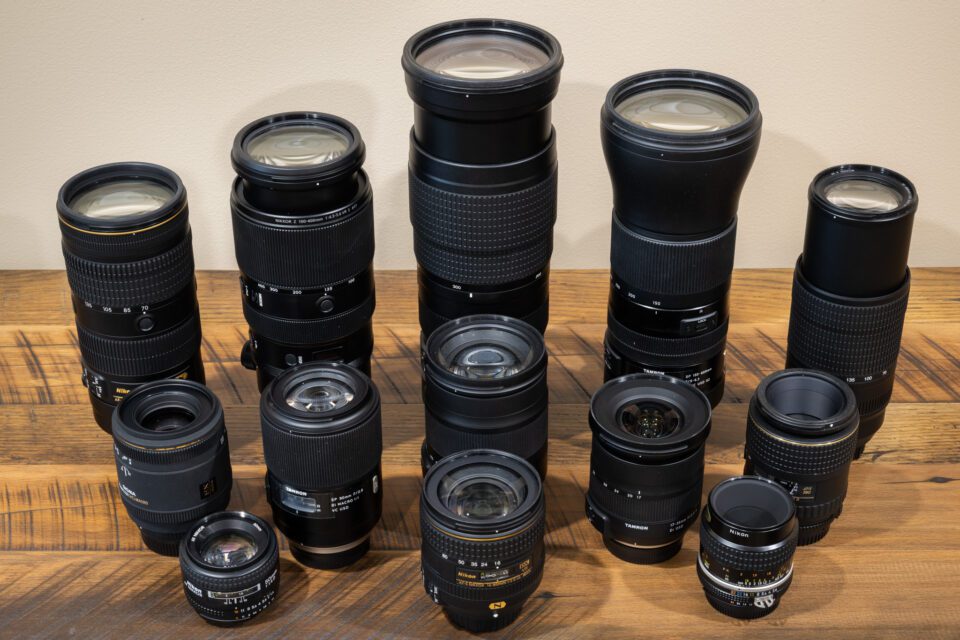
Fifty-fifty if cell telephone cameras keep improving and accomplish unimaginable levels of prototype quality, I'll always acquit around a larger, heavier, and more complex camera. Why is that? One word: lenses! An interchangeable lens camera opens upwardly a vast globe of photographic visions through a huge variety of eyes. Choosing amid the dozens and fifty-fifty hundreds of lenses can be disruptive and intimidating, so in this beginner'south guide, I'll explain the types of lenses available and what you lot should buy.
What Does a Lens Practice?
A lens focuses calorie-free to form an epitome on the photographic camera'south digital sensor or film plane, much the way our centre works. And importantly, a lens determines how much of the subject area is seen and captured, from the broad sweeping view of a wide angle lens to the narrow, selective view of a telephoto lens. We telephone call this the angle of view.
Lenses are classified past their specific focal length in millimeters. At the simplest level, this millimeter mark corresponds to the altitude between the lens'south optical center and the camera's epitome sensor when focused. From that focal length designation, we know how an image will look – in detail, the angle of view – on a given photographic camera. Focal length is the most of import factor to determine which lens to employ for a given photo.
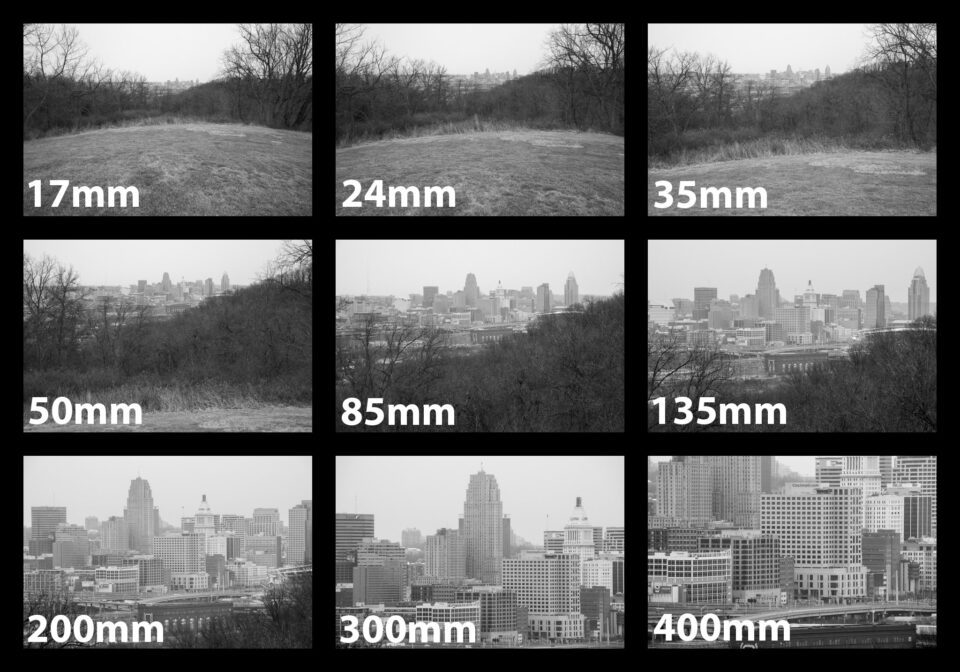
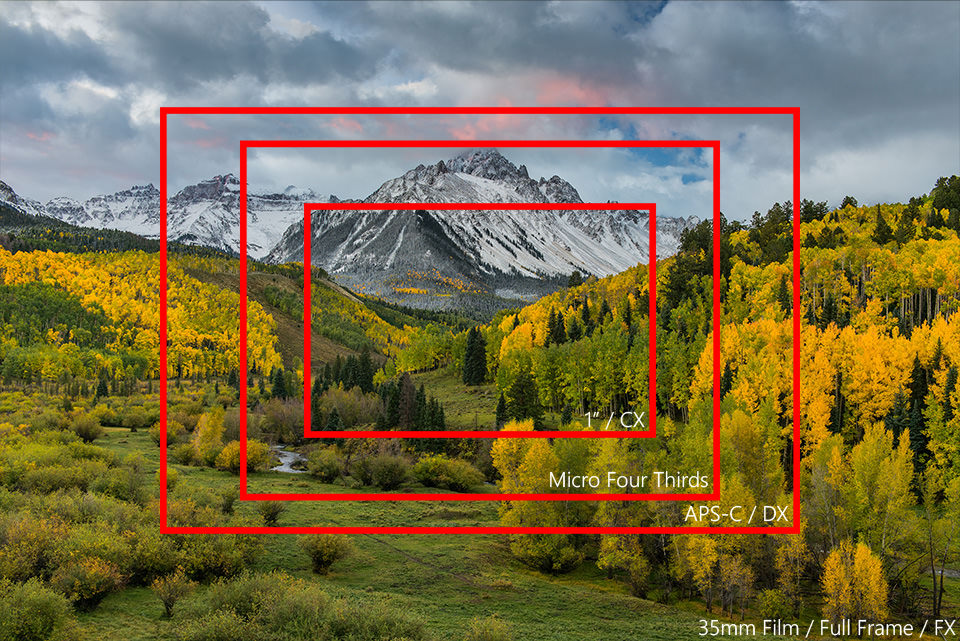
Note that the images above are taken with a full-frame camera – i.e., a camera with a sensor that'due south almost 24×36mm in size. If your camera has a smaller sensor like aps-c or Micro Four Thirds, it will human action as a "crop" of the images above and give a more zoomed-in appearance at each focal length. To be specific, aps-c cameras have about a 1.v× ingather factor, and Micro Four Thirds cameras have nigh a 2× crop factor. (For the remainder of this article, any time I mention specific focal lengths, I'll be doing and then in terms of a full frame camera. To get the equivalent number on your camera, information technology'due south as like shooting fish in a barrel as dividing by your crop factor.)
Forth with focal length, a lens also has a diaphragm that tin can change size – unremarkably called aperture – which controls how much light is let through the lens (part of how we command exposure). As your aperture changes, information technology looks similar this:
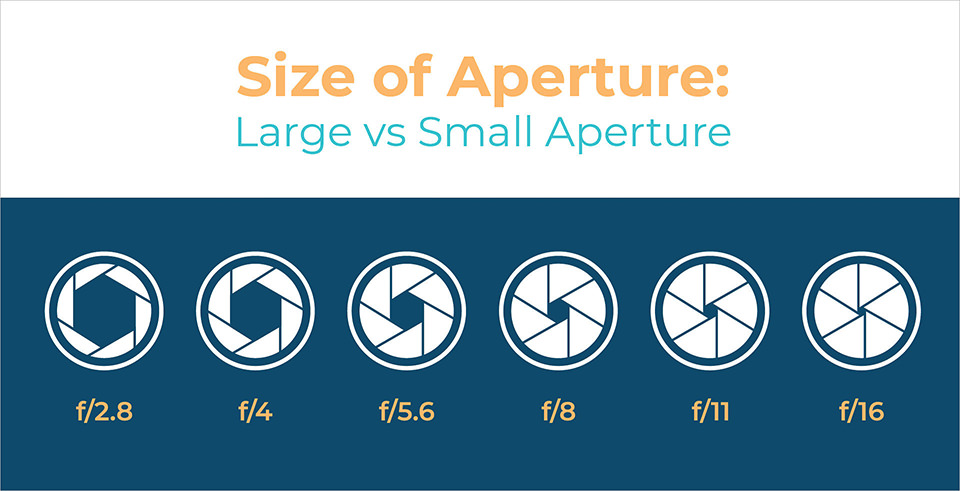
Every lens lets you lot change the aperture size, and so you're not stuck at one discontinuity. However, lenses are usually named by their maximum aperture because it's and then important – for example, the Nikon 28mm f/2.eight has a 28mm focal length and a maximum aperture of f/ii.viii. Other lenses have maximum apertures of f/4 or f/5.6 (which don't let in as much light), and some go the other direction to f/1.4 or f/ii (capable of capturing much more low-cal).
Discontinuity doesn't just alter how much light yous capture. It too determines how much of our subject is in focus from front end to back – what we call depth of field. As the discontinuity narrows, depth of field increases, which is why mural photographers often use apertures similar f/8, f/11, or f/xvi to go sharp focus from front to back.
Combined, these ii factors – focal length and aperture – are the most important features of a lens. If y'all know a lens's focal length(s) and maximum discontinuity, you already know a swell deal about what subjects it's intended to capture. I'll cover more than virtually those intended subjects next.
The Normal Lens
Lenses with a "middle" focal length – not super broad, not super telephoto – are known as normal lenses or standard lenses. Many photographers swear by the normal lens equally their principal tool because information technology does non exaggerate perspective and can be pressed into service for a wide variety of photographic needs. Photos taken with a normal lens experience like looking at the world with your optics, not a camera.
The normal lens for a given photographic camera system has a focal length similar to the diagonal length of that camera'due south sensor or moving picture. Full-frame cameras (again, with a roughly 24×36mm sensor) accept nearly a 43mm diagonal. The classic normal lens on total-frame is a 50mm, which is a bit longer than 43mm only pretty similar.
Normal/standard lenses were almost ever sold with the camera as a kit in the movie days of decades past. Today, there are withal plenty of 50mm lenses available from each manufacturer (or equivalents for smaller sensors like 35mm and 24mm lenses).
Everything from family unit candids, low-light street scenes, wedding group photos, and fifty-fifty landscapes look natural with a normal lens. It'southward a flexible tool.

NIKON D850 + 50mm f/1.8 @ 50mm, ISO 64, 1/4, f/xiv.0
Wide Angle Lens Drama
Broad angle lenses can be exciting to look through, as they take in a much more than expansive view than the normal lens and can be used to exaggerate perspective in pleasing ways.
A typical use for a wide bending is in a dramatic landscape, where the wide field of view allows you to become shut to an interesting foreground such as a field of wildflowers, while nevertheless capturing a sweeping view of the mountains in the background. Wide angles are also commonly used in architectural photography, such equally including all of the grand interior of a cathedral in the photograph.
On total frame, wide bending focal lengths range from most 10mm (uncommon and excessively broad for many uses) to 35mm (which is long enough that some photographers consider information technology a normal lens rather than a wide-angle).

NIKON Z 7 + NIKKOR Z 24-70mm f/2.eight South @ 24mm, ISO 400, 1/320, f/11.0
Telephoto Lens Power
A telephoto lens is like looking through binoculars – information technology has the power to bring your field of study upward close and personal. A telephoto has a selective angle of view and is ordinarily used to photograph more distant subjects such as wildlife or sports. It can also make pleasing head and shoulders portraits of people from a relaxed and comfortable distance.
If you can't get close to your field of study, chances are you lot will want a telephoto lens. They are my personal favorite lens type for landscapes, where I tin compose a moving-picture show of a photogenic section of a forest rather than taking in the entire hillside. Telephoto focal lengths begin at 70mm and keep upward to about 800mm.
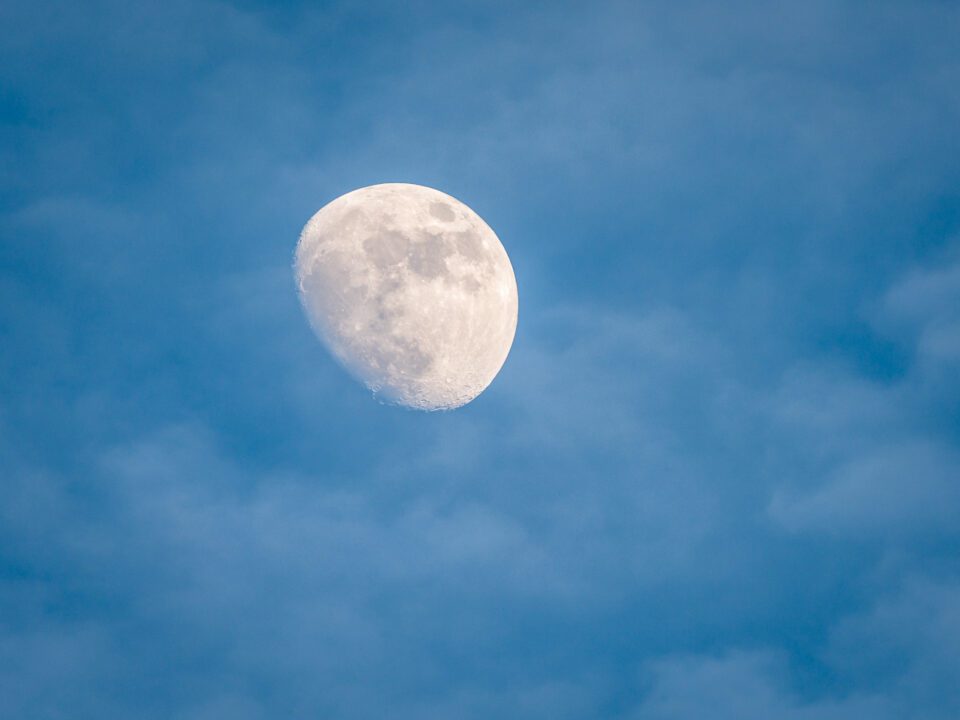
NIKON Z seven + 150-600mm f/5-vi.3 @ 600mm, ISO 160, ane/160, f/10.0
Specialty Lenses
Within the broad categories of wide angle, normal, and telephoto lenses, at that place are too more specialized optics. For example, a macro lens is designed to focus very shut so that tiny objects such as insects, flowers, or jewelry can fill the frame. Another specialty lens is the high-speed (or fast) lens, which has larger lens elements and a wider maximum discontinuity – keen for letting in more than light and capturing very shallow depth of field photos, where not much in the epitome is in focus.
Other speciality lenses included fisheye with its extreme and distorted field of view, tilt/shift lenses which are used by some architectural, studio, and landscape photographers to more precisely control perspective and focus, and the huge, exotic super-telephotos seen on the sidelines of major sporting events.

NIKON D7500 + TAMRON SP 90mm F2.8 Di Macro VC USD @ 90mm, ISO 400, i/200, f/5.half dozen
Primes vs Zooms
A prime lens has a single focal length, such as the 50mm normal lens. A zoom lens has a range of continuously variable focal lengths, such as a 24-105mm lens. Yous plough the zoom band on the lens barrel to zoom in from a wide-bending 24mm perspective toward a telephoto 105mm.
Prime lenses are frequently smaller and lighter than zooms, and they oftentimes have a larger maximum aperture. Prime lenses also tend to provide somewhat better optical quality than zooms. Merely zoom lenses win the convenience accolade, allowing you to carry one lens that replaces a whole bag of fixed focal length primes.
The very all-time zoom lenses these days are so skillful optically that nigh photographers volition not demand to worry about the optical differences. Both primes and zooms tin have their proper identify equally a photographer'southward lens kit grows.
Toll vs Functioning
Lenses come in all price ranges, and good options exist in the budget range. Spending more coin may go you a higher level of build quality, more refined optical qualities, or wider apertures, but for the beginner, there is no reason to overspend.
Whatever modern lens should allow yous to take pictures as excellent every bit your skills allow. If you do continue to enjoy photography and develop your skills, a time may come when spending more money will get you an upgrade in one of the aforementioned areas.
NIKON Z 9 + NIKKOR Z 24-120mm f/four S @ 58mm, ISO 64, twenty/1, f/16.0
OEM vs Third Party
Each camera manufacturer such every bit Canon, Nikon, and Sony has its own line of lenses designed to fit its specific cameras, and almost of these lenses tend to be very skillful to first-class and are a prophylactic pick. Just there are also third-party, lens-only manufacturers such as Sigma and Tamron who are turning out great optics and usually at lower prices than the OEM lenses. Perusing the lens reviews here at Photography Life will help requite you ideas of what lenses are bachelor and how they mensurate up.
New vs Used Lenses
New lenses are a safer bet every bit you commonly have 30-day return privileges if not satisfied, and you don't have to wonder how the lens was treated past previous owners. You also have a manufacturer'south warranty if you purchase from an authorized dealer for the make you choose.
For bargain hunters, used lenses can bring the reward of money saved, but there is the risk of getting a lens that does not perform equally it should. There are a wide diverseness of potential issues with precision products similar lenses, such as a lens element that is out of alignment, autofocus motors dying, grit or mold within the eyes, or wear and tear on the barrel.
I suggest beginners to buy new, or make sure in that location is a return privilege for used lens purchases purchased from a reliable seller (B&H Photo is an excellent choice for new and used; KEH Photographic camera is great for buying used with good warranty).

NIKON Z vii + Nikkor AI-S 55mm f/2.eight @ 55mm, ISO 64, 1 second, f/sixteen
Choosing One Lens to Start With
Armed with this basic introductory info near lenses, now the fun begins: choosing your offset one.
The classic, disciplined arroyo argues for a 50mm normal lens, and these accept the advantage of being among the most affordable, lightweight, small, bright (AKA wider discontinuity), and optically excellent lenses in whatsoever manufacturer'south line. As a beginner, using a 50mm lens for a wide multifariousness of photography volition teach you much about what your own needs are for your ultimate lens kit. If you photograph in small spaces, you may somewhen see the need for a wide angle, or if you spend much of your photography taking pictures of children'due south soccer, you'll shortly sympathise the need for a telephoto. A 50mm standard lens is a bang-up teacher.
If y'all want to photograph a broad diversity of subjects with convenience, a more versatile first lens purchase would exist a wide-to-telephoto zoom, something similar a 24-105mm or 28-200mm. With zooms like this, you'll have all the almost important focal lengths covered in 1 package, and you just need to turn the zoom band to find the correct perspective for your subject.
The more than modest the zoom range, the improve optical quality tends to be. 24-70mm lenses commonly beat 24-120mm lenses, which usually crush 24-200mm lenses. (They also tend to be lighter and/or take a larger maximum aperture.) I detect that 24-105mm and 24-120mm lenses are the best compromise. They're non simply a good first lens for beginners, simply also a beloved optic whatsoever fourth dimension you demand a versatile lens on your camera. I utilise a 24-120mm f/iv constantly on my own system.

NIKON Z seven + NIKKOR Z 24-120mm f/4 Southward @ 120mm, ISO 560, one/25, f/4.5
To add a scrap of discipline as you're starting out with a zoom lens like this, I recommend a beginner accept the 24-105mm zoom and for the commencement few months of their photography but use the lens at three marked focal length settings: 24, fifty, and 105mm. Information technology will be as if y'all have iii primes in your bag, and you'll learn from this exercise how to choose the focal length to accommodate the perspective and composition you want for each bailiwick.
If you are a beginner who already knows y'all are going to be spending near of your camera fourth dimension photographing sports or wild animals, and you lot only want one lens to start with, and then consider bypassing the wide and normal views and cull a seventy-300mm or 100-400mm as your first lens. This way you lot are equipped with the telephoto range needed for distant subjects, and you tin can use your iPhone for the normal and wide views when taking family unit snapshots or vacation pics.
Building A Multi-Lens System
Here'southward where it gets more fun! If you plan from the starting time to build a arrangement of ii or more lenses, you tin can expand on my recommendations higher up and apply multiple lenses that complement each other.
If choosing the versatile 24-105mm recommended above, lens number two (when you're fix) could be a 100-400mm to get a telephoto perspective, a 50mm f/1.8 to get a wider discontinuity, or a 16-35mm to become a wider angle view.
Alternatively, nature lovers may eventually want a macro lens to help capture close-ups of the tiny world, and a 100mm macro is a superb complement for almost any other lens kit. Since most macro lenses have a large maximum aperture of f/two.8 or so, they can likewise double as a portrait lens that offers a nice, shallow depth of field issue. Or yous can become to more exotic fast-aperture primes if portraiture is your specialty, such as a 85mm f/1.2 or 135mm f/1.viii.

NIKON Z seven + 70-200mm f/2.viii @ 80mm, ISO 64, 1/160, f/8.0
Savour the View!
Lenses are the life of the interchangeable lens photographic camera, and truly the best way for a beginner to expand their vision through the nearly limitless world of optics. From the drama of wide angles, to the just-correct comfort of the standard lens, to the powerful world of telephotos, the view from a adept lens is seductive and only may lure you into the joy of photography for the rest of your life.
I hope yous've glimpsed the fun that can await you every bit a beginner looking to cull your first lens or build a multiple lens arrangement. I welcome your comments below!
Source: https://photographylife.com/what-camera-lens-to-buy
Posted by: briggsoused1937.blogspot.com
0 Response to "How To Pick A Camera Lens"
Post a Comment